IUS Monthly Live in Nashville: October 2026
Live scanning, clinical implementation, and good company in Nashville
Highlights from October 13, 2026: live intestinal ultrasound demonstrations, practical guidance for launching an IUS service, clinical cases, and event photos. Free public recap with thanks to Gold Sponsors Johnson & Johnson and Pfizer and Silver Sponsor Lilly.
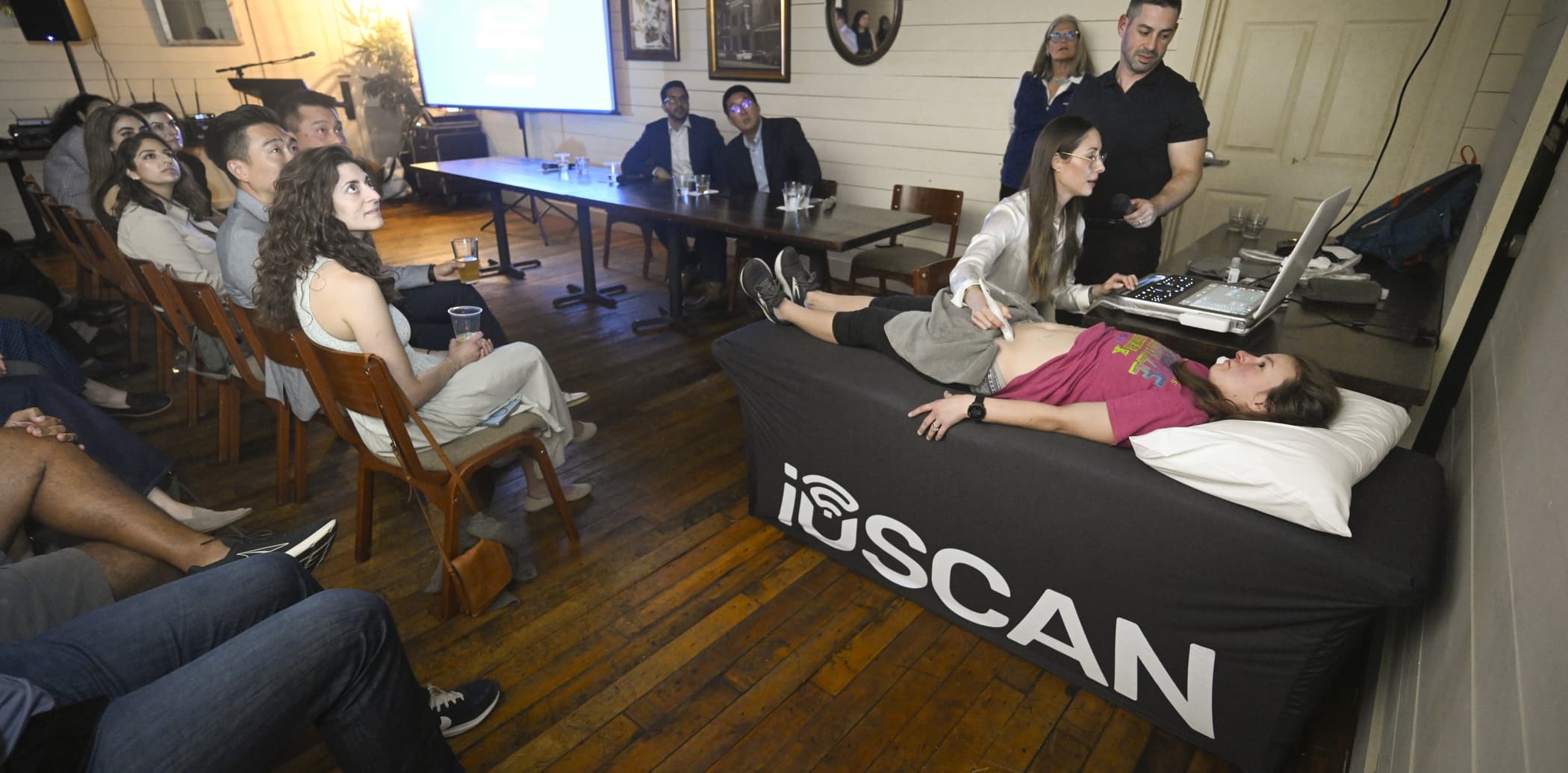
A front-row view of IUS in action as faculty demonstrate live scanning in Nashville.
The ultrasound machine had plenty of company in Nashville. On October 13, IUS Monthly Live brought clinicians together for an evening of practical teaching, live scanning, and conversation about bringing intestinal ultrasound into everyday inflammatory bowel disease care.
The agenda set the tone: have fun and learn something. Four faculty presentations connected the essentials of IUS with a question familiar to anyone hoping to build a service: how do we make this work in our own clinic?
That combination gave the evening its energy. Participants could see a scan unfold, connect the images to clinical cases, and explore the operational details that make a program possible. Between the presentations and conversations around the tables, there was plenty to take home.
We thank our Gold Sponsors, Johnson & Johnson and Pfizer, and our Silver Sponsor, Lilly, for supporting IUS Monthly Live in Nashville.
The presentations in focus
A clearer route into IUS training
Michael Dolinger, MD, MBA, opened with the clinical appeal of IUS: repeatable, real-time assessment without radiation or bowel preparation. His examples showed how ultrasound can map inflammation and evaluate strictures and penetrating complications. He also outlined iUSCAN’s approach to learning: eLearning and introductory hands-on teaching, followed by 100 locally performed examinations with virtual coaching every two weeks, an additional hands-on course, and competency assessment. The emphasis was on developing skills over time, with support close to the clinic where they will be used.
Ready to take the next step? Read the current iUSCAN training and certification announcement for details on the 2027–2028 cohort, or apply for IUS training. Applications close December 31, 2026.
Watch the technique come together
Noa Krugliak Cleveland, MD, connected ultrasound fundamentals to a systematic examination. Probe selection balances image resolution with depth; anatomic landmarks help orient the examiner; and a consistent scanning sequence helps keep the examination organized. She highlighted bowel wall thickness, Doppler vascularity, wall stratification, mesenteric fat, and complications as key findings to assess. The live demonstration made those concepts visible, with the probe, the screen, and the clinical explanation all in the same room.
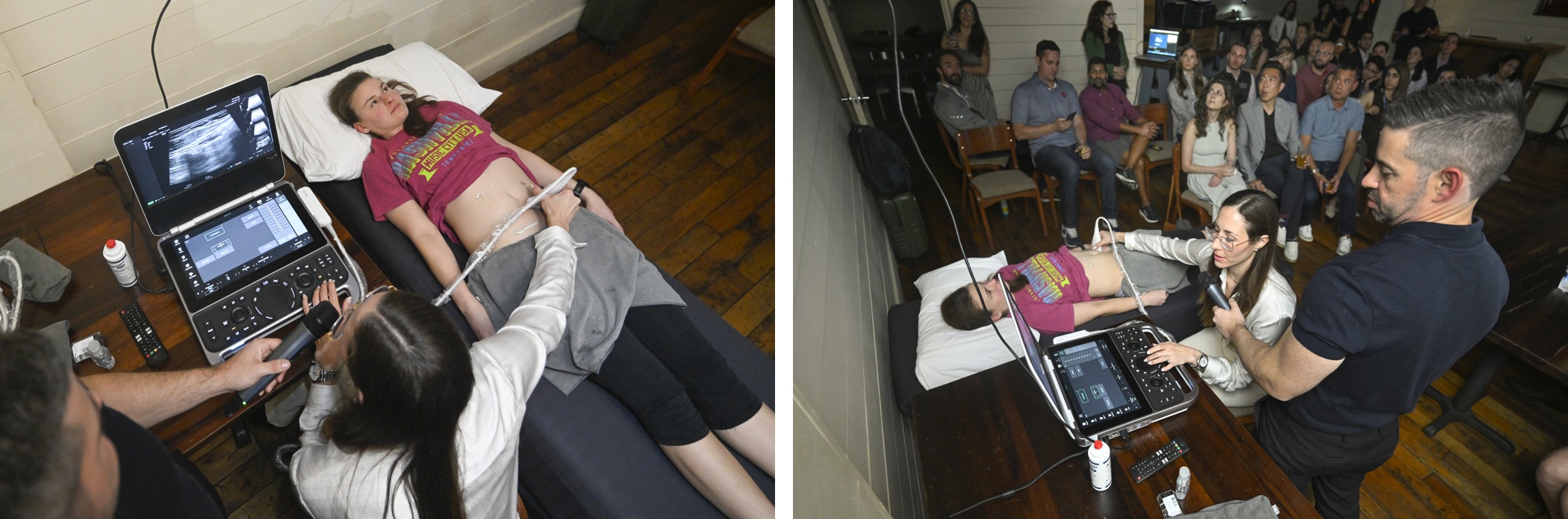
Probe placement, image interpretation, and questions come together during the live demonstration.
Clinical cases give the images context
Baldeep S. Pabla, MD, MSCI, used Crohn’s disease and ulcerative colitis cases to illustrate serial assessment, including postoperative recurrence and treatment response. His UC discussion included TRUST&UC, which detected changes in bowel wall thickness as early as two weeks. The cases emphasized interpreting IUS alongside symptoms, biomarkers, endoscopy, and the wider clinical picture. They also showed why feeling better and having less inflammation deserve separate attention.
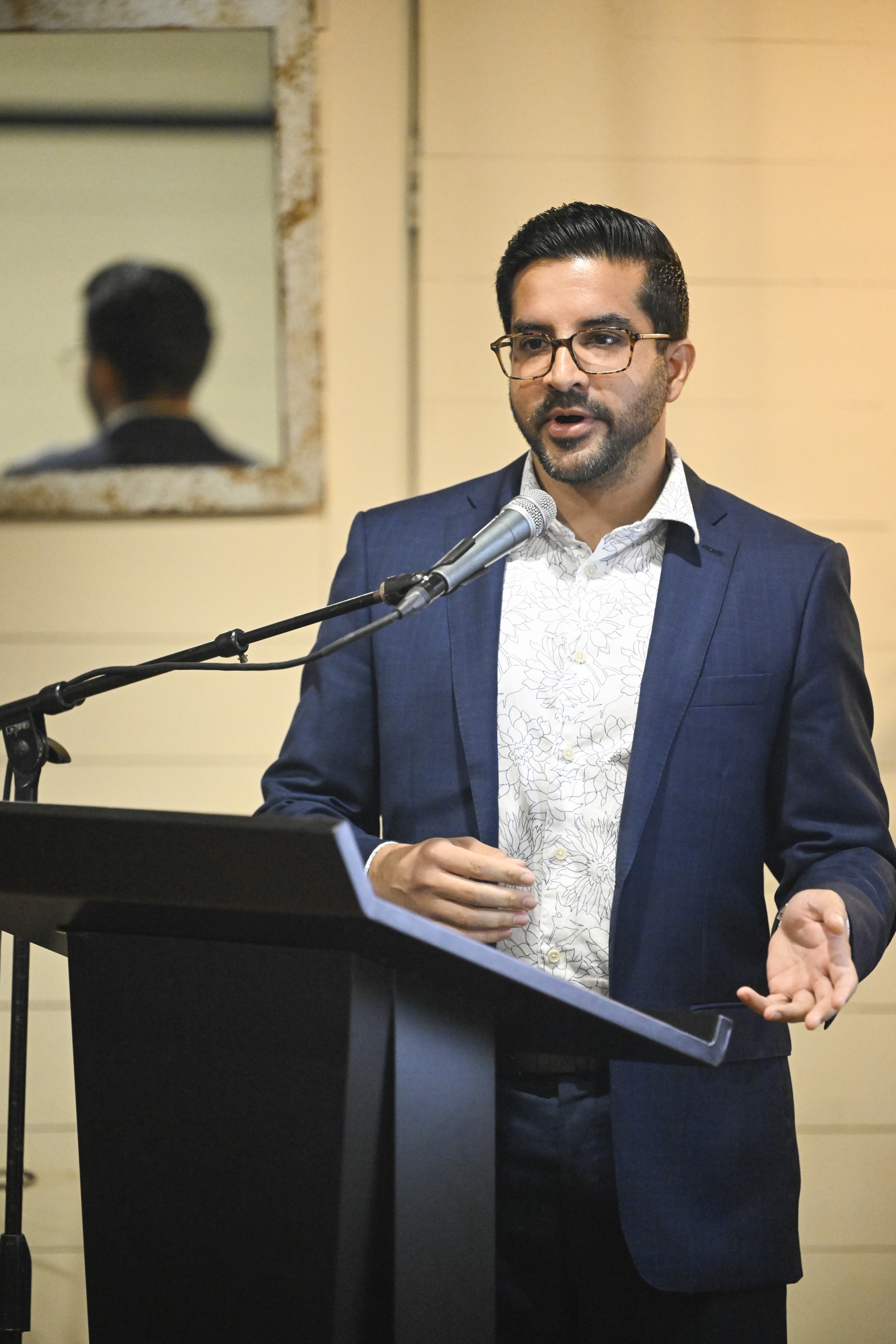
Dr. Baldeep Pabla presents intestinal ultrasound cases in Crohn’s disease and ulcerative colitis.
Making the case for an IUS service
The most detailed practical discussion centered on implementation. Phillip Gu, MD, Director of the IBD Intestinal US Program at Cedars-Sinai and Chair of iUSCAN’s Clinical Implementations Committee, laid out a path that begins well before the first clinical scan. Dolinger’s business-planning slides reinforced the same message: enthusiasm needs a workable budget and a realistic plan for growth.
Lead with the patient care problem
Dr. Gu framed the proposal around what IUS can add to a practice: real-time information, opportunities for shared decision-making, and assessment without radiation, bowel preparation, or anesthesia. He also discussed potential institutional value through program differentiation, research, and more efficient use of resources. For a new service, those are reasons to define measurable goals and evaluate them during a pilot.
Build a budget your own clinic can defend
The financial examples accounted for equipment, training, maintenance, supplies, and scan volume. Dolinger encouraged conservative expectations as a service builds experience and referrals. Dr. Gu paired his illustrative financial projections with a practical next step: pilot volume, then compare actual revenue, staffing time, and referral demand with the original plan. The useful takeaway was the planning method. Local costs, collections, and available capacity determine the business case.
For a practical starting point, explore Dr. Rishika Chugh’s Blueprint for Building an IUS Program: From Passion to Practice and the iUSCAN business template shared through the presentation’s QR codes.
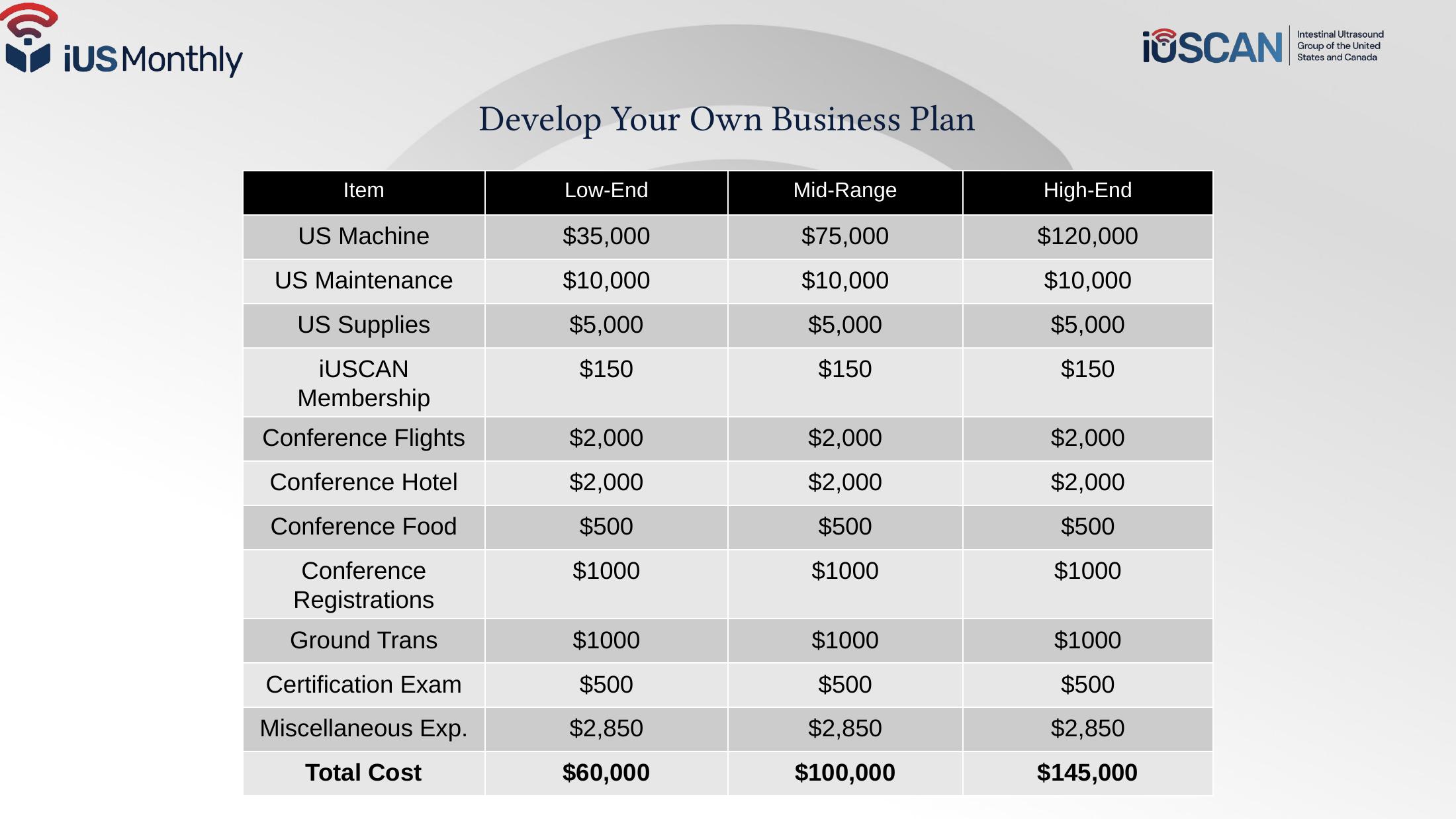
Develop Your Own Business Plan. These event examples illustrate cost categories; local equipment, training, and operating costs determine each practice’s budget.
Give the launch a sequence
Dr. Gu organized implementation into three stages. In months 1–3, align GI and IBD clinicians, clinic administration, IT, radiology, and billing; choose equipment and initial operators; and settle room access, storage, image archiving, electronic records, consent, and credentialing requirements. In months 4–12, pilot scans in IBD clinic and through colleagues’ referrals, use structured reports, test patient billing, and correlate selected examinations with other objective assessments. In months 12–24, review actual volume, adoption, revenue, and clinical impact before expanding access and adding education or research opportunities.
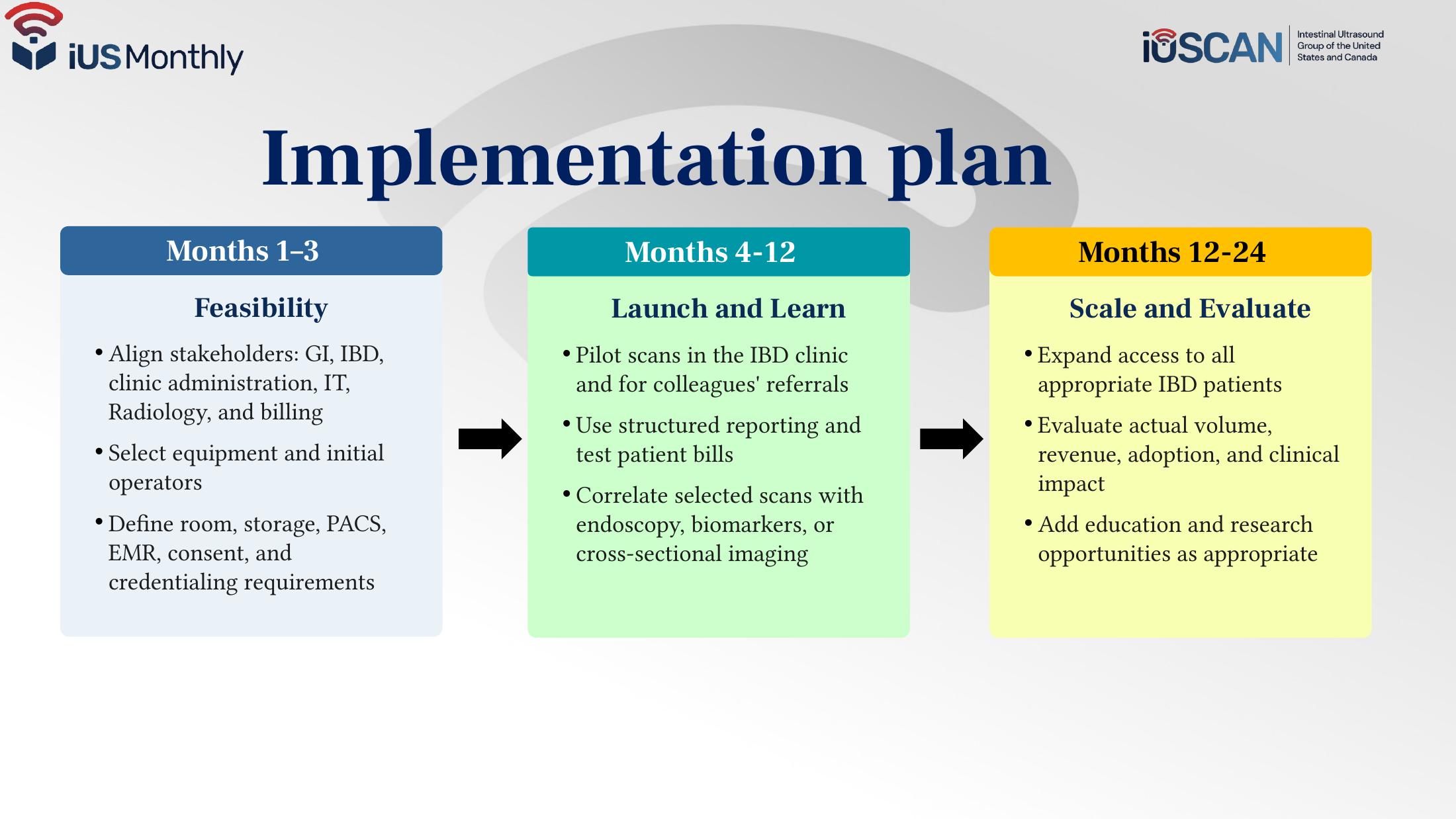
Dr. Gu’s phased implementation plan connects preparation, piloting, and expansion.
For a clinician ready to begin, that sequence turns a large project into concrete conversations: who needs to be involved, what needs to be ready, and what will tell us the pilot is working?
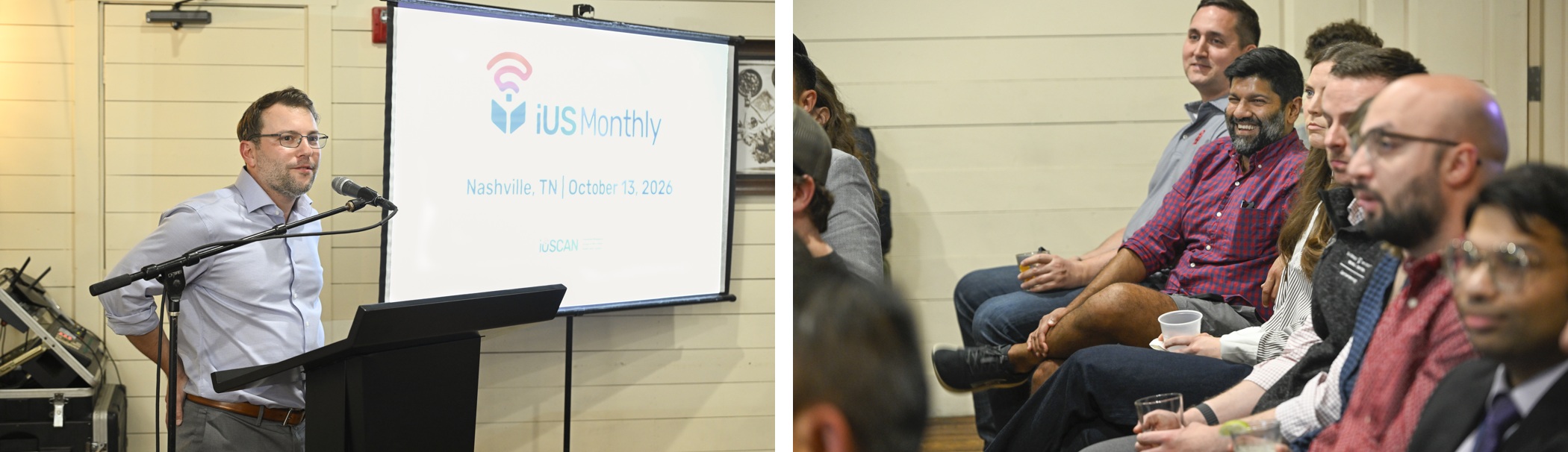
Faculty teaching and an attentive audience bring the practical questions into the room.
Fitting IUS into the clinic day
Choose the appointment model that fits
Dr. Gu described two models. Same-visit IUS allows clinicians to connect findings with treatment discussions during their own appointments. His practical tip was to begin with longer slots or a modified clinic template while building confidence. Dedicated IUS appointments create focused scanning time and access for colleagues’ patients, with ultrasound technologist support where available. The right starting model depends on the people, space, and scheduling capacity a clinic can support.
Make the scan easy to find and compare
A sustainable service needs a consistent record. Dr. Gu emphasized evaluating all accessible bowel segments, using standardized labels, measurements, and Doppler conventions, and saving still images and cine loops to the picture archiving and communication system, or PACS. Structured documentation should record bowel wall thickness, vascularity, complications, examination confidence, and interval change. Those details help the next clinician understand what was seen and make follow-up examinations more useful.
Work through billing before expanding
Orders, documentation, and billing were part of the implementation discussion. Dr. Gu reviewed CPT 76705 and discussed 93976 in connection with dedicated spectral Doppler measurements. These were planning points to review with local billing and credentialing teams, rather than an assumption that every examination qualifies for the same codes or reimbursement. Testing the process during the pilot helps teams understand what patients and the practice will experience.
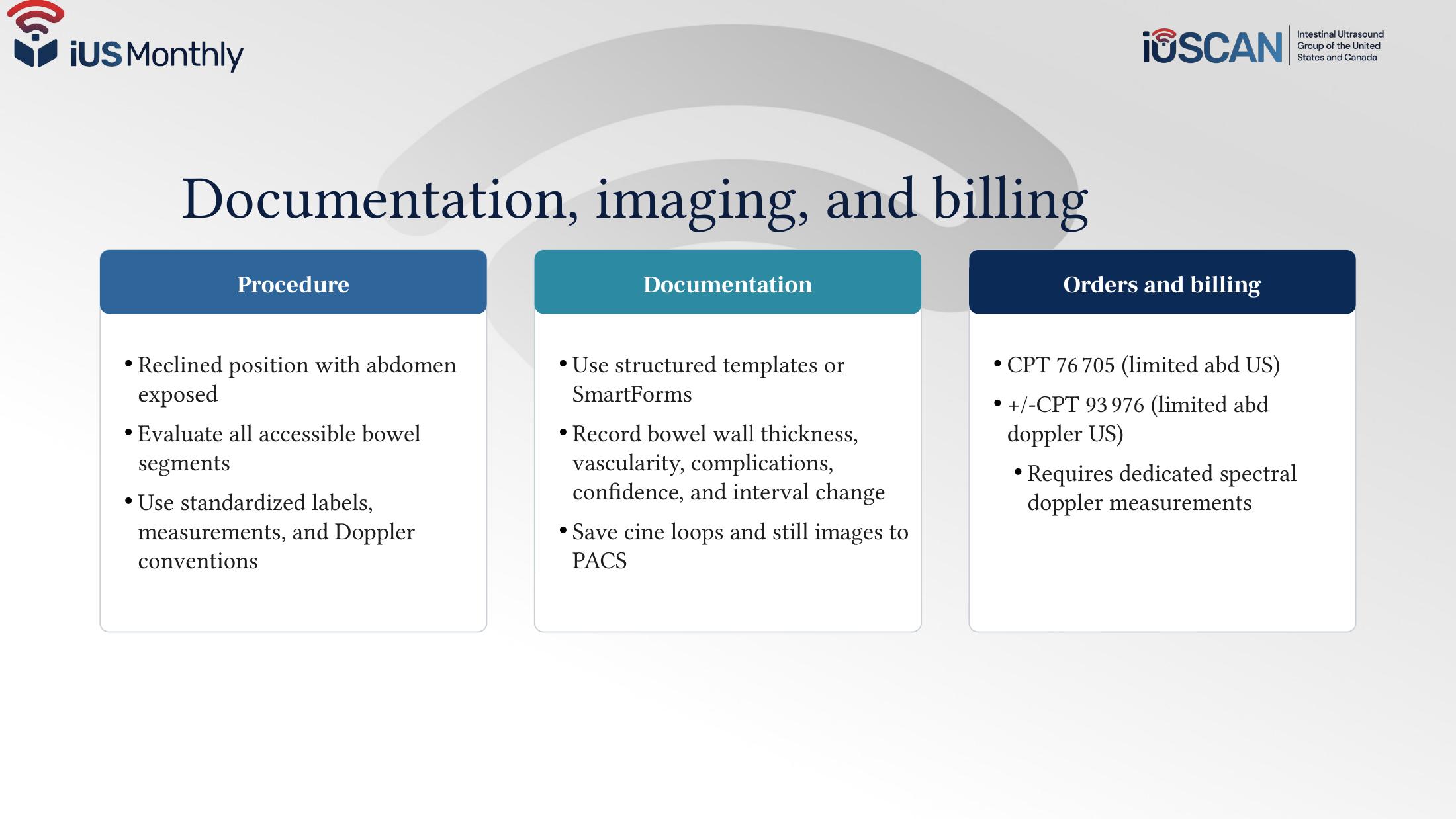
Documentation, imaging, and billing considerations presented by Dr. Gu. Coding and reimbursement require local review.
Connect follow-up to the clinical question
Dr. Gu also presented example monitoring intervals within a treat-to-target approach: baseline assessment when starting a new therapy, reassessment after induction at roughly 8–12 weeks, and further assessment during maintenance. His postoperative example paired IUS and fecal calprotectin at about three months with colonoscopy at 6–9 months. He also discussed monitoring during pregnancy and stable remission. These proposed schedules illustrated how IUS can fit alongside other assessments; timing remains individualized to disease activity, treatment, and clinical need.
The iUSCAN Clinical Implementation Blueprint gives teams a place to continue that work, with business-planning resources, an implementation framework, documentation guidance, and billing information.
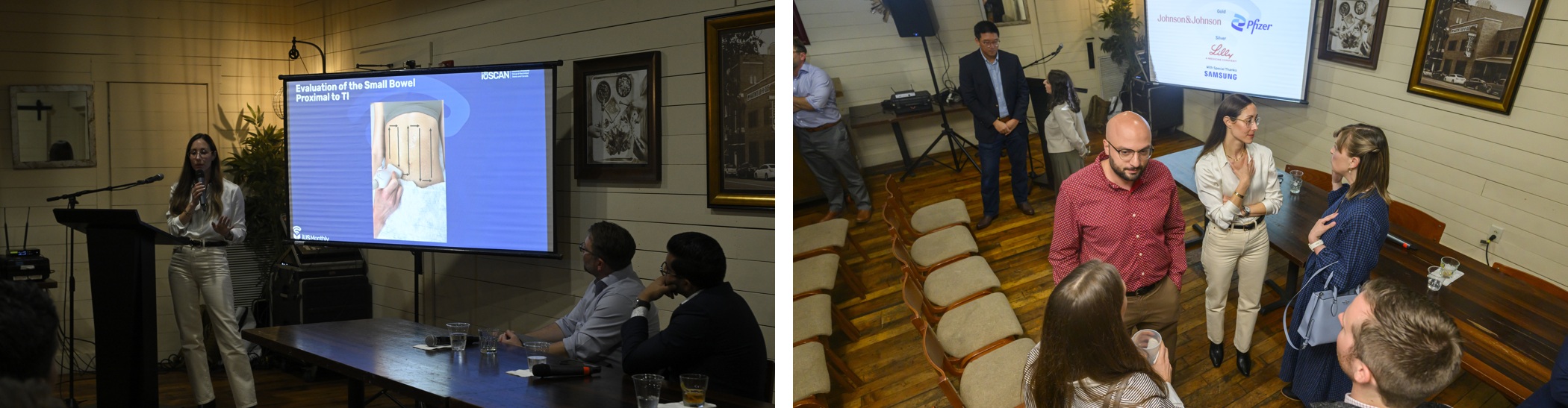
Learning together and continuing the conversation beyond the presentation.
Good company is part of the program
The photos tell the other half of the Nashville story: small groups talking around tables, colleagues catching up, and plenty of smiles between the teaching sessions. IUS Monthly Live made room for the social side of learning as well as the scan itself.
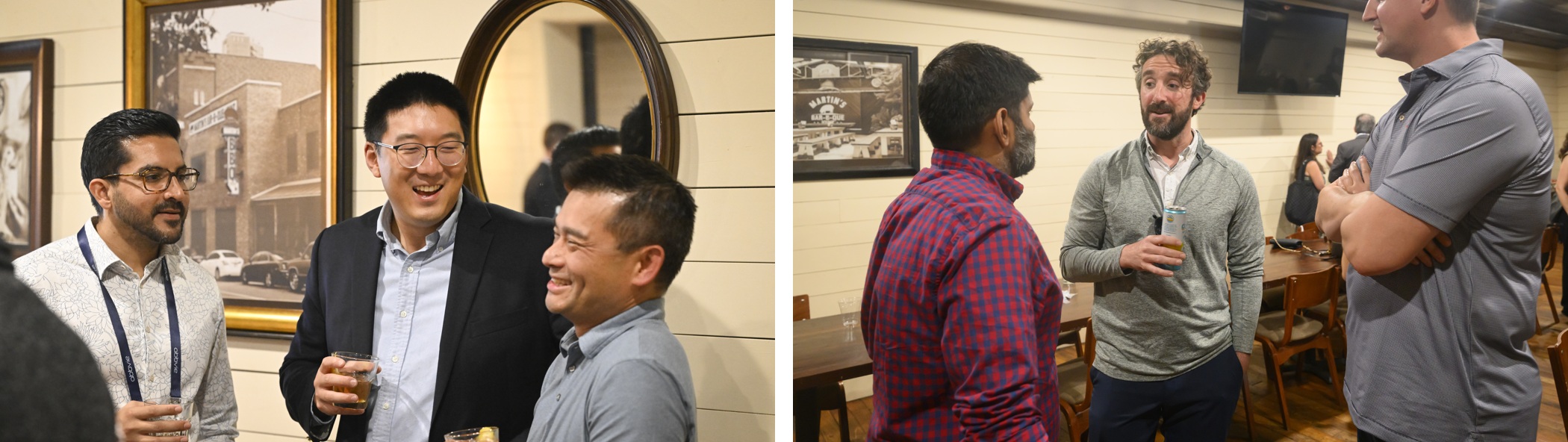
Conversations around the room give colleagues a chance to connect.
That is an appealing combination for clinicians exploring IUS. A presentation can introduce the technique; a live demonstration lets people watch it happen; and an informal conversation creates space to explore what implementation could look like at home. Nashville brought all three into one evening.
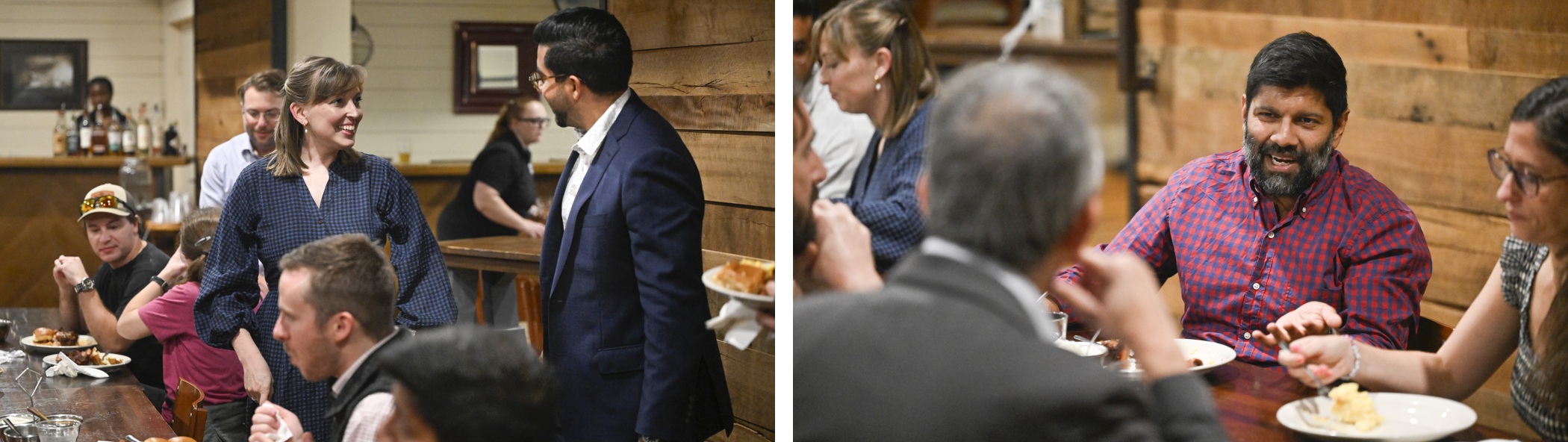
A shared table and a lively discussion round out the Nashville evening.
With thanks to our sponsors
Gold Sponsors | Johnson & Johnson and Pfizer
Silver Sponsor | Lilly
We are grateful for their support of this opportunity for clinicians to learn, connect, and explore the practical use of IUS in IBD care. Nashville offered a clear picture of what this event format can bring together: clinical education, live demonstration, and a community eager to keep the conversation going.
Keep learning with iUSCAN
Implementing Intestinal Ultrasound in Your Practice
Blueprint for Building an IUS Program From Passion to Practice